
Collecting the news

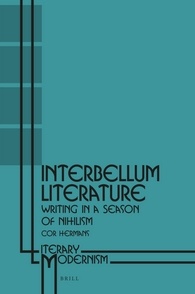
In August 2017 my new book Interbellum Literature: Writing in a Season of Nihilism has been published by Brill (Leiden/Boston).
For some reason the twentieth century has produced many exceptional writers, despite its tragedies. The period between the two world wars can be called ‘a season of nihilism’. Unable to come to terms with the moral defeat of the First World War, many from the thirties onward knew that a new wave of destruction was about to hit the shores. Nevertheless the Interbellum stands out as the heyday of modern literature. These troubled times also witnessed an outburst of literary creativity. How can this be explained? In this book I present and analyse the literary and philosophical ideas in the novels, plays and stories of Proust and Joyce, Musil and Broch, Céline and Jünger, Woolf and Sartre, Orwell and Zweig, Gide and Camus, Kafka and Simone Weil, Beckett and Hemingway, Arthur Miller and Eugene O’Neill, Hesse and Thomas Mann, Joseph Roth and F. Scott Fitzgerald, Aragon and Tzara.
More information: http://www.brill.com/products/book/interbellum-literature


All this implies that … the so-called classical liberals, who nowadays call themselves neo-liberals or libertarians, claim Mill’s ideas and contend they follow in his footsteps. The Dutch historian Cor Hermans modifies this image thoroughly in his highly readable book Een Engelsman in Frankrijk …. In it he doesn’t deny that the famous philosopher played an important role in the history of European liberalism, but he demonstrates … that [Mill] was also influenced, and substantially so, by the Romantic Movement, socialism, and positivism.
Dirk Verhofstadt, 17 October, 2008, www.liberales.be
His main source of inspiration Mill found with Coleridge and Carlyle, Saint-Simon, Tocqueville and Comte. In his book Cor Hermans presents us with a detailed study of all these different spheres of influence. He succeeds in unearthing their connections, while writing expressively and well documented, and in showing how they were brought together in Mill’s writings in a harmonious way to form a masterly whole. Also very interesting is how Mr Hermans places these philosophical and sociological views in their historical context… Mr Hermans brings to life a Mill who radically engaged in the improvement of the fortune of both individual and society …
Willy Deckers, De Leeswolf, nr. 8, 2008
Cor Hermans discovered in Mill first of all the passionate rationalist, with an open eye for the moral and institutional shortcomings of democracy. His quest for ‘liberation through reason’ still is, and very much so, a topical subject … It will take you some long evenings to make yourself familiar with the Mill that Mr Hermans outlined. But it will be a rewarding experience. A refreshing view on Mill and an interestingly written history of ideas of the nineteenth century, including the striking notion that a merciless striving for personal gain is not everything, as we know by now, having suffered the banking crisis of overextended loans.
Willem Breedveld, Trouw, 31 October, 2008
Mr Hermans not only demonstrates that utilitarianism is much more interesting and wide ranging than is commonly assumed, he also shows that it is not justified to criticise Mill for being an ‘unsystematic’ thinker. (…) The Mill that Mr Hermans presents in his erudite and excellently written book made great demands on himself, such as ordinary mortals could never satisfy; however, he also was a very prolific and stimulating philosopher, who but little resembled the wooden Victorian schoolmaster looking down on us in photographs and paintings.
Rob Hartmans, De Groene Amsterdammer, 13 June, 2008
It’s his merit that he has placed Darwin himself clearly in the foreground as originator of the debate on social evolution in the second half of the nineteenth century. Against this there is the drawback that Mr Hermans has not resisted the temptation to walk every side-road he encountered in his long trail of study. He needs quite a lot of space to both distinguish and connect all the diverse currents. (…) In spite of these critical remarks, in my final verdict appreciation for this clever piece of work of Mr Hermans takes precedence.
Jan Breman, Amsterdams Sociologisch Tijdschrift, 31 (2), 2004
… an excellent academic dissertation …
Guido Kindt, Het Medisch Weekblad, 12 February, 2004
 Cor Hermans